


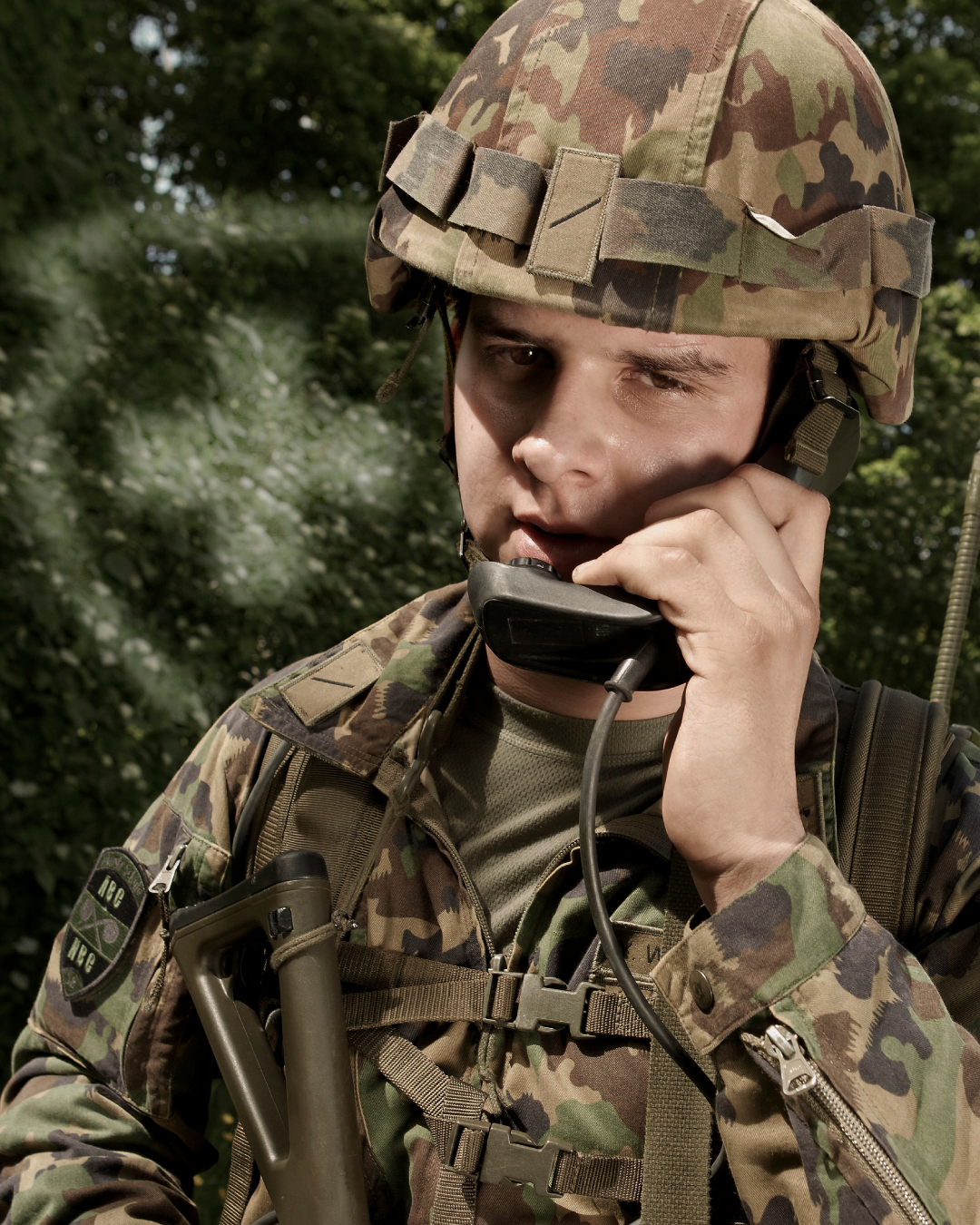
An Overview of Military Ranks in the Swiss Armed Forces
The Swiss Armed Forces, known for their neutrality and their ability to defend the country, possess a diverse and structured hierarchy of ranks that allows soldiers to clearly define their positions and responsibilities. From recruits to high-ranking officers, there is an extensive number of service grades and ranks in the Swiss Armed Forces, which reflect both the military hierarchy and the different duties and areas of expertise within the armed forces.
These ranks are not only a form of recognition for the soldiers' service and commitment but also play a decisive role in the organization, coordination, and efficiency of the army.
On this page, you will find a detailed overview of the service grades and ranks of the Swiss Armed Forces.
General Information About Service Grades in the Swiss Armed Forces
Law:
The rank structure of the Swiss Armed Forces was established by the Swiss Parliament in accordance with Article 102 of the Military Act (MG). The Federal Council is authorized to introduce additional service grades for enlisted personnel and non-commissioned officers. Changing officer ranks requires an amendment to the law by Parliament. Unlike other armed forces, members of the Swiss Air Force use the same rank titles and insignia as members of the Army.
Retention of Rank:
Individuals who have been promoted to a specific rank retain it even if they no longer hold the corresponding position, though specialist officers only retain their ranks after six years of service. Former members of the armed forces who have been discharged from military service obligations have the option to continue using their last held rank with the suffix "retired" (abbreviated: "ret." or "a. D." in German).
Service Grades in Other Areas of the Swiss Military:
Rank titles are uniform across the Army and Air Force branches, as well as in other areas of the armed forces such as the Armed Forces Command Support Organization or the Armed Forces Logistics Organization.
Designation for Women in the Swiss Military:
Women in the armed forces have access to all positions. They hold the same rank titles as their male colleagues, meaning there is no need for feminine designations such as "Wachtmeisterin" or "Hauptfrau."
Rank Insignia:
Insignia for ranks in the armed forces are divided into two types:
- Fabric insignia worn on the dress uniform (attached to both shoulders).
- Velcro insignia attached to the duty and combat uniform (only on the right collar tab and headgear; the left collar tab identifies the troop branch according to classification).
Since January 1, 2006, metallic rank and function insignia as well as name tags have been replaced by fabric insignia (Velcro) that correspond to NATO standards.
Military Rank in Switzerland
The following grades / ranks exist in the Swiss Armed Forces:
Enlisted Ranks
|
Military Rank |
Explanation |
Insignia |
|
Recruit (Rekr) |
A recruit in the Swiss military is a new soldier who is in basic training. During this time, they are trained in military skills, discipline, and operational readiness. |
They wear no insignia. |
|
Soldier (Sdt) |
In the Swiss Armed Forces, "Soldier" is the lowest service grade and one of the most common enlisted ranks. In practice, the title often depends on the troop branch, for example, Scout (Aufkl), Infantryman (Inf), Grenadier (Gren), Gunner (Kan), Sapper (Pi), Motor Transport Driver (Motf), or Medical Soldier (San Sdt). In international missions, the soldier is referred to as Private or Private E-1 (Pte). Unlike other armies, there is no automatic promotion to Private First Class after a few months of service in the Swiss Armed Forces. |
The soldier wears an angled bar as rank insignia.
|
|
Private First Class (Gfr) |
In the Swiss Armed Forces, the Gefreiter (short: Gfr) is an enlisted rank qualified to act as a deputy squad leader. Unlike in other armies, promotion to Gefreiter does not occur automatically after a certain period of service. Prerequisites are a minimum qualification of "very good" and at least 20 days of training service within the formations. The promotion is carried out by the company commander. The Gefreiter receives higher pay. In international missions, they are referred to as Private or Private E-2 (Pte). NATO rank code: OR-2. |
The Gefreiter wears two angled bars as rank insignia.
|
|
Corporal (Obgfr) |
The rank of Obergefreiter in the Swiss military was created in 2004 and designated a specialist who takes on tasks with greater responsibility or the function of a deputy squad leader. The rank of Obergefreiter could be achieved during NCO training in recruit school or through promotion during a refresher course for soldiers with very good performance. However, since the "Further Development of the Army" (WEA) reform in 2018, no further promotions to Obergefreiter have been made, and the rank was abolished as of January 1, 2019. In international missions, the Obergefreiter is referred to as Private First Class (PFC), with the NATO rank code OR-3. |
The rank insignia of the Obergefreiter consists of three angled bars.
|
Non-Commissioned Officer (NCO) Ranks
|
Military Rank |
Explanation |
Insignia |
|
Corporal (Kpl) |
In the Swiss Armed Forces, a Korporal is the lowest NCO rank (NATO rank code: OR-4). Before the Army XXI reform (WEA) in 2004, the Korporal was a squad leader. Since Army XXI, the Wachtmeister has assumed this function. Since the Further Development of the Army (WEA), Korporale are technical specialists without leadership functions. They are also deployed in specialized areas such as field post or NBC defense and receive special NCO training. Since the WEA, no further promotions to this rank have been made. In international missions, the Korporal is referred to as Corporal (Cpl). |
The rank insignia of the Korporal in the Swiss Armed Forces is represented by a single chevron.
|
|
Sergeant (Wm) |
The rank of "Wachtmeister" in the Swiss military designates an experienced squad leader who has completed their training. Before the Army XXI (WEA) reform in 2004, this rank was awarded to experienced squad leaders who were appointed as platoon leader deputies due to their skills and performance. Since 2004, Wachtmeister has been the rank title for a squad leader who has completed their training. Training to become a Wachtmeister includes recruit school, NCO school, and practical service. In international missions, the Wachtmeister is referred to as a Sergeant. |
The rank insignia of the Wachtmeister shows a chevron with a Swiss cross enclosed in foliage.
|
|
Staff Sergeant (Obwm) |
The Oberwachtmeister is a military rank in the Swiss Armed Forces that was introduced on January 1, 2004. It is awarded to a platoon leader deputy and requires additional training beyond that of a squad leader (Wachtmeister). This rank often serves as a transition to Lieutenant during practical service. In international missions, the Oberwachtmeister is referred to as Sergeant First Class (SFC). NATO rank code: OR-5. |
The rank insignia of the Oberwachtmeister consists of a single chevron with a horizontal bar below it. Additionally, the insignia displays a Swiss cross enclosed in foliage.
|
Senior Non-Commissioned Officer (SNCO) Ranks
|
Military Rank |
Explanation |
Insignia |
|
Feldweibel (Fw) |
The Feldweibel is the lowest service grade of the senior NCOs in the Swiss military and corresponds roughly to a German Feldwebel. Prior to the Army XXI (WEA) reform, the Feldweibel held two main functions:
Since the Army XXI (WEA) reform in 2004, the rank of Hauptfeldweibel was introduced for Company Sergeant Majors. The rank of Feldweibel is now reserved only for the technical sergeant. Only specialist senior NCOs remain in the rank of Feldweibel. In international missions, the Feldweibel is referred to as a Sergeant Major. |
The rank insignia for the Feldweibel consists of two overlapping chevrons with a Swiss cross above, surrounded by foliage.
|
|
Quartermaster (Four) |
The Fourier in the Swiss military is a senior NCO who acts as a leadership assistant to a unit commander. Their main tasks include the company's provisioning and bookkeeping as well as managing the commissariat service. The latter includes troop subsistence (catering), troop accounting (bookkeeping, pay), and lodging procurement. The Fourier is professionally subordinate to the Quartermaster and works closely with the troop accountant and the head cook. In the NATO rank code, the Fourier is listed as OR-7, while in international missions, they are known as a Quartermaster Sergeant. |
Since January 1, 2004, the Fourier has worn a rank insignia with a horizontal bar, which clarifies their equivalent status with the Hauptfeldweibel in the hierarchy.
|
|
Company Sergeant Major (Hptfw) |
The Hauptfeldweibel is a service grade in the Swiss Armed Forces introduced on January 1, 2004, as a new rank for the unit sergeant major. In international missions, they are referred to as Chief Sergeant Major (CSM). Their NATO rank code is OR-7. Hauptfeldweibel are responsible for the administrative operation of a company and often act as the company commander's right hand. They organize routine operations, regularly check troop numbers, carry out special tasks in barracks management, are responsible for accommodation and hygiene, manage equipment, and organize logistics and material deliveries. They can also take over vehicle management and troop transport if no transport officer is available. |
The insignia shows two chevrons arranged on top of each other with a horizontal bar below. Above them is a Swiss cross, framed by foliage—also known as the ordnance cross.
|
|
Warrant Officer (Adj Uof) |
The Adjutant Unteroffizier (Adj Uof) is a rank in the Swiss military that is primarily held by professional NCOs. An Adj Uof can also serve in a militia capacity as a logistics NCO, chief mechanic, or accident response platoon leader. Before the 1990s, the Adj Uof was the highest NCO rank, but with the introduction of Army 95, further ranks such as Staff Adjutant, Chief Adjutant, and Senior Adjutant were added. During international missions, the Adj Uof is referred to as a Warrant Officer (WO), according to NATO rank code OR-8. |
The rank insignia shows two chevrons on top of each other with a Swiss cross enclosed in foliage and another chevron above.
|
|
Staff Warrant Officer (Stabsadj) |
The Stabsadjutant in the Swiss military is a rank that was introduced on January 1, 1996, in the course of the new Military Act. This military rank encompasses various tasks in both professional and militia service. In militia service, the militia Stabsadjutant is an advisor to the commander on non-officer-related matters at the battalion or detachment level. They are also the professional superior of NCOs and Hauptfeldweibels. To reach this rank, an NCO must generally complete at least three refresher courses in their role and demonstrate high qualifications in leadership and training. In professional service, the professional Stabsadjutant can act as a class instructor at candidate schools or assume higher functional responsibility as a Chief of Professional Training or head of a specialist department. They are often also involved in leading positions for the development of training courses and the instruction of teaching staff. According to the requirements of the Swiss Armed Forces, a Stabsadjutant must be an experienced and competent senior NCO who possesses leadership and training experience and acts as a role model. In international missions, they are referred to as a Staff Warrant Officer (SWO). |
The rank insignia of the Stabsadjutant shows two chevrons on top of each other and a Swiss cross in the middle, enclosed in foliage. Additionally, two more chevrons are visible above the foliage-enclosed Swiss cross.
|
|
Master Warrant Officer (Hptadj) |
The Hauptadjutant is a rank of the Swiss Armed Forces that has existed since January 1, 2004. This military rank is held by professional NCOs who serve as leadership assistants to school commanders, as well as senior NCOs of the militia deployed on a brigade staff. In international missions, the Hauptadjutant is referred to as a Master Warrant Officer (MWO). The tasks of the Hauptadjutant are varied. As the right hand of a school commander, they are, among other things, responsible for personnel matters and act as a trusted confidant for all employees. They are responsible for the development and career planning of school personnel and often also take on other tasks such as leading courses for senior NCOs. Militia Hauptadjutants, on the other hand, are deployed in various leadership areas on the brigade staff, including personnel, intelligence, logistics, and territorial service. They fulfill their duties according to a specific job description. |
The rank insignia consists of two chevrons on top of each other. Below this is a Swiss cross surrounded by foliage. Under the Swiss cross are two additional chevrons with a horizontal bar below them.
|
|
Chief Warrant Officer (Chefadj) |
The Chefadjutant is a rank of the Swiss Armed Forces that has existed since January 1, 2004. It is the highest NCO rank. A Chefadjutant is deployed as a leadership assistant to a commander of a territorial region, the Army Commander, the Air Force Commander, or the Chief of the Armed Forces. In international missions, they are referred to as a Chief Warrant Officer (CWO). The military rank of Chefadjutant is held by professional NCOs in training formations as well as militia NCOs on the staff of a territorial region. |
The rank insignia consists of two chevrons on top of each other. Below this is a Swiss cross surrounded by foliage. Under the Swiss cross are two chevrons with two horizontal bars below them.
|
Officer Ranks - Subaltern Officers
|
Military Rank |
Explanation |
Insignia |
|
Lieutenant (Lt) |
The Lieutenant is the lowest officer rank in the Swiss Armed Forces. Unlike the previous service period (Army 95), a platoon leader is not promoted automatically; instead, they normally remain a Lieutenant for two refresher courses or a maximum of 4 years. In international deployments, they are referred to as Second Lieutenant (2Lt). According to "Army XXI", promotion to First Lieutenant occurs after completion of the entire Lieutenant training and two refresher courses or after four years of seniority as a Lieutenant. A militia Lieutenant serves about four weeks per year and must complete a total of 680 days of service before being discharged. |
The rank insignia shows a 3 mm wide stripe.
|
|
First Lieutenant (1st Lt) |
The First Lieutenant in the Swiss Armed Forces is typically a platoon leader and may also serve as an acting company commander. Promotion takes place according to specific criteria, either based on performance after three refresher courses or regardless of performance after six courses. During basic and advanced training, a First Lieutenant may be deployed as a company commander. In international deployments, he is referred to as a First Lieutenant. Promotion to First Lieutenant in Switzerland under Army XXI occurs after completion of Lieutenant training and two refresher courses or after four years of seniority as a Lieutenant. His duties include leading a platoon, deputizing for the company commander, or serving as a quartermaster in a staff. Occasionally, a First Lieutenant may also serve as a service chief in a battalion staff. The NATO rank code is OF-1a. |
The rank insignia shows two 3 mm wide stripes.
|
Officer Ranks - Captains
|
Military Rank |
Explanation |
Insignia |
|
Captain (Capt) |
A Captain in the Swiss Armed Forces often assumes the role of a company or battery commander, but can also work in a staff. As a career officer, he frequently serves as a unit career officer or as a class instructor at an officer school. In international deployments, he is referred to as a Captain and corresponds to the NATO rank code OF-2. Army chaplains also hold the rank of Captain. |
The rank insignia shows three 3 mm wide stripes.
|
Officer Ranks - Staff Officers
|
Military Rank |
Explanation |
Insignia |
|
Major (Maj) |
The Major is the lowest rank in the staff officer group and can also achieve the equivalent rank of "Major in the General Staff". Promotion to Major requires at least eight years as an officer, including at least four years as a Captain, as well as appropriate training and recommendations from the brigade. Majors often serve as deputies to commanders at various levels and as chiefs of staff in battalion staffs, frequently with a dual rank of Capt/Maj. They are also deployed in command areas at the brigade and territorial level. Majors may belong to the General Staff Corps (Maj Gst). Their duties range from deputy functions to battalion commander. In career service, they may work as unit career officers or instructors at officer schools, while in the militia function they serve as commanders or staff members in larger units. In international deployments, they are referred to as Major (Maj). |
A Major wears one wide stripe as rank insignia.
|
|
Lieutenant Colonel (Lt Col) |
The rank of Lieutenant Colonel in the Swiss Armed Forces is positioned between Major and Colonel and represents the fifth-highest officer rank in peacetime. In addition to the Lieutenant Colonel, there is the equivalent rank of "Lieutenant Colonel in the General Staff". Within the framework of international deployments, the Lieutenant Colonel is referred to as Lieutenant Colonel (LTC/Lt Col) according to NATO rank code OF-4. The duties of a Lieutenant Colonel vary depending on the area of deployment. As a commander, he is responsible for leading a battalion, a department, or a squadron. Alternatively, he acts as a staff officer and assumes leadership of a specialist area in the brigade staff. A Lieutenant Colonel in the General Staff (Lt Col Gst) typically leads the leadership areas 2 (Intelligence), 3 (Operations), or 5 (Planning) in the brigade staff. |
The rank insignia of the Lieutenant Colonel in the Swiss Armed Forces shows two wide galloons to signify his position and responsibility within the armed forces.
|
|
Colonel |
The rank of Colonel in the Swiss Armed Forces has assumed various functions over time. Previously, the Colonel was often a regimental commander. With the abolition of regiments during Army XXI in 2004, however, his deployment shifted more into staffs and higher leadership functions. Today, he serves, among other things, as a staff officer in larger units and command areas. In brigades, the Colonel often assumes functions such as deputy brigade commander or chief of staff. As a career officer, he can also take on leadership roles, such as commander of a military school or command. In international contexts, the Colonel corresponds to the rank of Colonel. Within the Swiss Armed Forces, he ranks above the Lieutenant Colonel and below the Brigadier. He thus belongs to the highest officer ranks below the senior staff officers. The duties of a Colonel are diverse. He can be commander of a command, for example in specialized areas of the army or air force. Furthermore, he assumes specialist and leadership functions in higher-level staffs. Colonels are also deployed in military justice, for example as presidents of military courts. |
The rank insignia of a Colonel shows three wide stripes.
|
|
Specialist Officer (Spec Off) |
The Specialist Officer in the Swiss Armed Forces is a member of the enlisted ranks, non-commissioned officers, or higher non-commissioned officers who is occasionally or permanently entrusted with officer duties due to exceptional knowledge, aptitude, or skills. Career NCOs are excluded from this, as they cannot reach officer rank due to legal regulations even with high qualifications. As a rule, these are soldiers with enlisted, NCO, or higher NCO ranks. Due to their professional skills and competencies, they are recommended for specific tasks that would normally require an officer (except for leadership tasks). Depending on the function, the Specialist Officer can usually be classified into ranks from First Lieutenant to Colonel, which determines his pay and his rights and duties. In international deployments, he is referred to as a Specialist Officer and corresponds to NATO rank codes OF-1a to 5, depending on the type of deployment position. The designation Specialist Officer is often supplemented with the corresponding salary grade, e.g., Specialist Officer (Capt) for a specialist officer with the duties of a Captain. The rights and duties of a Specialist Officer are identical to those of a career officer in the same position, from Lieutenant to Colonel. They receive functional pay according to their rank level. Specialist officers must complete all courses and deployments associated with their function and position, except for training services for a higher rank. However, as specialists, they are only obligated for a maximum of 300 days of training service. In the Swiss Armed Forces, Specialist Officers assume special tasks such as Press and Information Officer (PIO), Tactical Fighter Controller in military Air Traffic Control (ATC) Operator, Chief of Personnel (S1), Legal Advisor, etc. |
Specialist Officers wear special, standardized rank insignia. A rhombus is visible on these.
|
Officer Ranks - Senior Staff Officers
|
Military Rank |
Explanation |
Insignia |
|
Brigadier (Brig) |
Before the Army XXI reform, the Brigadier was considered the highest achievable rank for militia officers in the Swiss Armed Forces. Since this reform, brigades represent the largest unit formations commanded by a Brigadier. Infantry brigades have about 8,700 soldiers, while armored brigades have about 10,000. Some Brigadiers perform their functions part-time. In an international context, a Brigadier is referred to as a Brigadier General (Brig Gen), corresponding to the NATO rank code OF-6. Previously, until 1977, the rank was referred to as Colonel Brigadier. Before 1969, there were also Brigadiers without a direct command, particularly for uniformed chief officials. These were distinguished by gray shoulder straps and wore a uniform cap with a laurel wreath on a gray background. A Brigadier can be a brigade commander, commander of a training unit, Chief of Army Personnel, or Chief of International Relations Defense (C IR D). |
The rank insignia for the Brigadier in the Swiss Armed Forces shows a star surrounded by laurel.
|
|
Division Commander (Div) |
The rank of "Division Commander" in the Swiss Armed Forces is a significant rank marked by two stars on the shoulder straps. This rank, which corresponds to the two-star rank (OF-7), belongs to the group of senior staff officers. Originally known as Colonel Division Commander, it was called this until 1977. In an international context, a Division Commander is referred to as a Major General (Maj Gen), according to NATO code OF-7. A Division Commander can hold various important positions in the Swiss Armed Forces, including that of Major General, commander of a territorial division, Chief of the Army Staff, commander of the Land or Air Forces, or commander of the Armed Forces Logistics Organization. |
The rank insignia of a Division Commander shows two vertically arranged stars surrounded by laurel leaf strips.
|
|
Corps Commander (CC) |
In the Swiss Armed Forces, the rank of "Corps Commander" denotes the highest rank in peacetime, which internationally corresponds to the rank of Lieutenant General. Previously, this rank was called Colonel Corps Commander until it was changed in 1977. The Corps Commander is the highest-ranking officer in the Swiss Armed Forces during peacetime. However, in the event of mobilization, a General is appointed as Commander-in-Chief. Prominent examples of officeholders with the rank of Corps Commander are the Chief of the Army as well as the Chief of the Joint Operations Command and the Chief of the Training Command. Interestingly, some important positions such as the Defense Attaché in Washington also hold the rank of Corps Commander. Before 2003, the Chief of the General Staff and the commanders of the army corps were also Corps Commanders, but since 2004, no army corps exist in the Swiss Armed Forces. Abroad, the Corps Commander is referred to as Lieutenant General and bears the NATO abbreviation Lt Gen. |
The rank insignia of a Corps Commander shows three vertically arranged stars surrounded by laurel.
|
Officer Ranks - Commander-in-Chief of the Army
|
Military Rank |
Explanation |
Insignia |
|
General |
In Switzerland, a General only assumes the role of Commander-in-Chief of the Army during war mobilization. This General is appointed by the Federal Assembly and remains subordinate to the Federal Council. In peacetime, command of the troops lies with the Chief of the Army (CdA). Occasionally, the Commander-in-Chief of the Army is referred to as a four-star General. A General is only elected when a major troop deployment is planned or decreed. According to Article 85 of the Military Act, the Federal Assembly elects the General upon proposal by the Federal Council. His function ends as soon as the crisis is averted. Since the Second World War, however, this office has not been filled. |
The rank insignia of a General in the Swiss Armed Forces shows four vertically arranged stars framed by laurel leaves.
|


